
Pre-submittal Tribal Meeting Request
Some applications require an offer of a meeting with tribal representatives before submittal to the City for review/decision.
The City of Albuquerque is committed to tribal engagement related to proposed development that may affect tribal communities. The steps below outline the process for offering a meeting to tribal representatives for applications that may trigger the tribal meeting requirement.
Step 1: Check the IDO
Check IDO Table 6-1-1 to see whether your application requires you to offer a Tribal Meeting to tribal representatives.
The Integrated Development Ordinance (IDO) requires prospective applicants to offer to meet with tribal representatives for certain application types before submitting the application to the City for review/decision.
- In Table 6-1-1, if there is an X in the "Tribal" column, then you must email the Planning Department to see if the subject property triggers the requirement to offer a pre-submittal Tribal Meeting.
Step 2: Read Tribal Meeting Requirements
Review IDO Subsection 14-16-6-4(B), which explains the Pre-submittal Tribal Meeting Requirements.
Tribal Meetings are intended as an early opportunity for tribal representatives to learn about proposed development and to discuss opportunities and address any concerns before the application is finalized and sent into the City's review and approval process. This process is part of the City's commitment to tribal engagement for development that may impact tribal communities.
Step 3: Request Confirmation from Planning Staff
If your application meets the criteria in Table 6-1-1 and Subsection 14-16-6-4(B), fill out this online form so that Planning staff can confirm whether a pre-submittal tribal meeting will be required based on proximity to Major Public Open Space or tribal land.
Tribal Meeting Inquiry Online Form to Planning Staff
Step 4: Email Forms and Required Attachments
Contact Information for Tribal Representatives
If you are required to offer a tribal meeting, Planning staff will email you the list of contact information for tribal representatives to send the offer of a tribal meeting:
- Email to tribal representatives, if provided OR
- Certified mail, if no email address is listed.
Tribal Meeting Request Form
Email or mail the completed Tribal Meeting request form to the list of contacts and attach any additional information, as necessary.
Providing detailed information helps tribal representatives determine whether they have concerns that warrant a meeting or whether they are satisfied that the project does not pose any concerns.
Note: The Tribal Meeting could take up to 60 days to occur, so applicants are encouraged to plan accordingly.
Use Acrobat Reader (free to download) to fill these forms out electronically.
Tribal Meeting Request Form to Send to Tribal Representatives
Attachments to Explain Your Project
Attach the items below, as relevant to your project, to the mail and email or upload them to a website or a cloud-storage site where they can be accessed and downloaded.
If you attach documents to your email, PDFs and small file sizes are best. Uploading them to a website or cloud-storage site is best for large file sizes.
- Zone Atlas page (or a Site Location Map or Google Map) with the property clearly identified
- Visit AGIS zone atlas grid map to locate the Zone Atlas page that contains your project.
- Download the corresponding Zone Atlas page.
- Mark up the map to clearly identify the project site.
- Proposed Subdivision (plat)
- Proposed Master Development Plan
- Proposed zone change request and intended development, including uses with square footages for non-residential development and/or dwelling unit types and total numbers for residential development
See also:
Step 5: Alert Planning Department of a Request for Tribal Meeting
If any tribal representative requests a Tribal Meeting, email [email protected] so that the Planning Department can arrange a facilitator from the City's Alternative Dispute Resolution (ADR) office.
Once assigned, the ADR facilitator will handle the scheduling and convening of the Tribal Meeting, facilitate the meeting, produce the summary, and distribute it to all attendees who provide email addresses.
The meeting can also be facilitated by a neutral third party if both the applicant and the tribal representative agrees to the facilitator.
Step 6: Prepare for the Tribal Meeting
Prepare the following information, as applicable to the project, to present at the Tribal Meeting, as required by IDO Subsection 14-16-6-4(B)(6).
- Proposed uses
- Approximate square footages for non-residential development
- Approximate dwelling unit numbers and types for residential development
- General site layout
- Design guidelines
- Architectural style
- Conceptual elevations
- Conceptual landscaping plans
Step 7: Submit Your Application
All applications are submitted through ABQ-PLAN.
When the application for the proposed project is submitted to the City, the applicant must include the following items, as relevant.
- If an offer of a Pre-submittal Tribal Meeting WAS required:
- Meeting request email with forms and required attachments sent to Tribal Representatives.
- If the offered meeting was REQUESTED by Tribal Representatives:
- Meeting Summary by ADR or third-party facilitator.
- Written explanation of how the project addressed tribal concerns and opportunities or why they could not be addressed.
- If an offer of a Pre-submittal Tribal Meeting WAS NOT required:
- PDF of the email from [email protected] confirming that a tribal meeting offer was not required.
The City will not accept incomplete applications.
See also:
- Public Notice (Mailed & Electronic Mail)
- Boards and Commissions for agendas and meeting materials.
- Contact the Planning Department at [email protected] or call 505-924-3857, option 1, and ask to speak to the case planner associated with the relevant decision-making body for more information.
- Some applications will be automatically deferred to the following hearing date to provide a 30-day comment period for tribal representatives.
-
- See the EPC webpage for more information.
-
- Post-submittal Facilitated Meeting
Need More Help?
If you have questions about the IDO tribal engagement process, please contact Planning staff.
If you have questions about the doctrine of Free, Prior, and Informed Consent, please contact the City's Tribal Liaison.
Office of Native American Affairs
Terry Sloan, Office of Native American Affairs Liaison
Email: [email protected]
Phone: 505-768-3041
Sample Attachments
For the following attachments, be sure that images and attachments are clearly labeled and include “DRAFT” and the current date.
Aerial image with the site identified. Label surrounding roads to provide context.
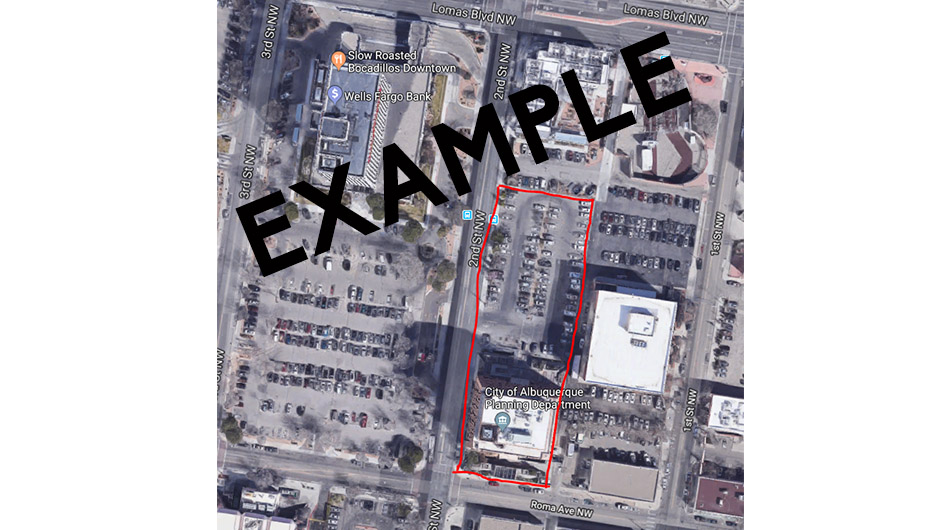
Zone Atlas Page with the site identified. Include Address.

General Site Layout. Provide full sheet if necessary to show details.

Conceptual elevation

Conceptual landscaping plan
