

FAI Ballooning Commission Announces 2026 Hall of Fame Inductees
Induction ceremony will take place at the Balloon Museum in October.
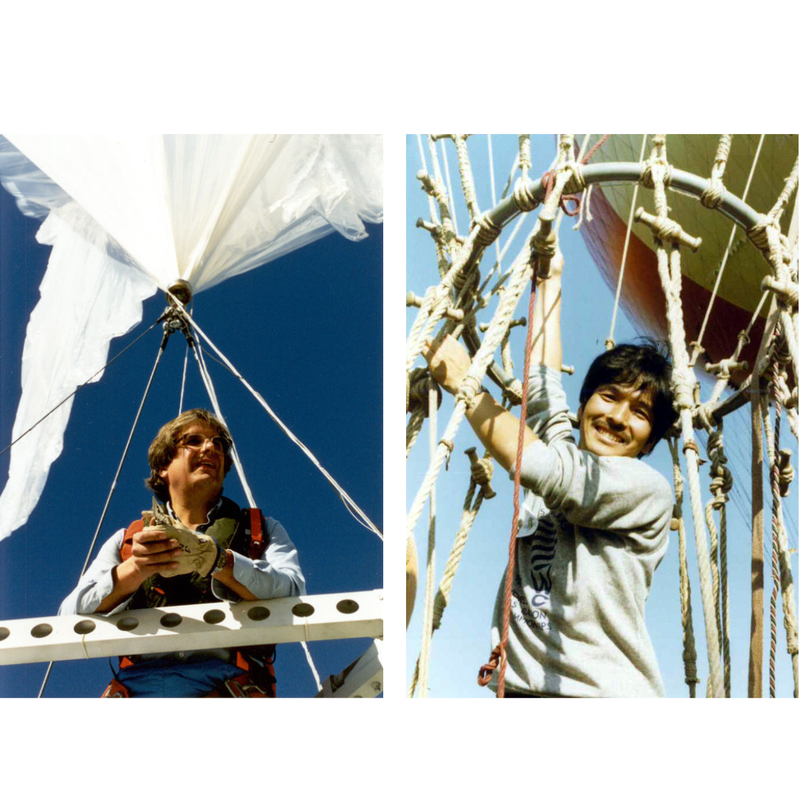
The Fédération Aéronautique Internationale (FAI) Ballooning Commission (CIA) announced its 2026 Hall of Fame inductees during its plenary meeting in AlUla, Saudi Arabia, in early February. The FAI Ballooning Commission and the Anderson Abruzzo Albuquerque International Balloon Museum, home of the FAI Ballooning Commission’s Balloon and Airship Hall of Fame, applauds this year’s honorees: living inductee Saboru “Sabu” Ichiyoshi of Japan and posthumous inductee Julian Nott of the United Kingdom and the United States.
The induction ceremony will take place at the Balloon Museum on Friday, October 2, 2026. The FAI Ballooning Commission and the Balloon Museum extend their congratulations to the honorees and their families on this distinguished recognition.
Saburo Ichiyoshi (1946 - )
Saburo “Sabu” Ichiyoshi is widely recognized as a central architect of modern Japanese ballooning, a pilot whose career bridges postwar history, international sport aviation, and institutional leadership. Born in Tokyo in 1946, Ichiyoshi developed an early fascination with balloons through exposure to paper gas “jumping balloons,” reminiscent of Japan’s wartime Fu-Go program. Determined to pursue lighter-than-air flight at the highest level, he earned his gas balloon pilot license in Augsburg, Germany, in 1972. At a time when modern sport ballooning infrastructure in Japan was still developing, his European training introduced advanced competition standards and operational practices that would influence the future of the sport in his home country.
In 1976, Ichiyoshi became the first Japanese pilot to complete a solo hot air balloon flight over Mount Fuji, a symbolic and technical milestone that marked the arrival of contemporary sport ballooning in Japan. Two years later, in 1978, he achieved an altitude of 8,295 meters (27,215 feet) in Western Australia, demonstrating both technical precision and performance capability at the upper limits of hot air ballooning. Throughout his career he established multiple Japanese national records in 1978, 1999, 2000, and 2001, and achieved an AX-10 duration record of 41 hours and 29 minutes, underscoring his mastery of endurance flight and meteorological strategy. In 1990, he undertook an ambitious attempt to overfly Mount Everest, landing in the Himalayas. This expedition reflected the exploratory spirit and high-altitude ambition that defined much of his career.
On 25 September 1994, Ichiyoshi led one of the most historic flights in Asian ballooning. With co-pilots Maco Oiwa, Masao Masuda, Susumu Tatsumi, and Kenji Komura, he completed the first successful hot air balloon crossing from Pusan, South Korea, to Yamaguchi, Japan. Launching at 09:07 JST and landing at 13:19 JST, the team traveled 125 miles (201 kilometers) across the Sea of Japan in 4 hours and 12 minutes. The flight required meticulous meteorological planning, precise fuel management, and international coordination, and stands as both a technical achievement and a symbol of regional goodwill and aviation diplomacy.
Beyond his personal flight accomplishments, Ichiyoshi played a foundational role in building Japan’s ballooning institutions. He served as Chairman of Nippon Kikyu Remmei, the Balloon Federation of Japan, from 1982 to 1985, helping formalize training standards, align Japan with international competition frameworks, and foster participation in global events. Internationally, he represented Japan within the Fédération Aéronautique Internationale (FAI) Ballooning Commission (CIA), later serving as CIA Vice President from 1997 to 1998. He contributed to the CIA Records Review Subcommittee and served for multiple years on the FAI Ballooning Hall of Fame selection committee, helping define record validation standards and recognize the sport’s most distinguished contributors. His leadership helped integrate Japan firmly into the global ballooning community.
Ichiyoshi’s contributions were further amplified through his role as the Japanese representative for Cameron Balloons, through which he introduced advanced equipment, modern envelope and burner systems, and international safety standards to Japanese pilots. As founder of Aeronauts Inc., he provided equipment, flight planning, and regulatory support for balloon and airship activities in Japan, strengthening the operational foundation for future generations. His lifetime achievements have been honored with the Montgolfier Diploma (1993), the Paul Tissandier Diploma (1999), and the Niwa Prize (1990 and 1996), recognizing both his technical accomplishments and his service to aeronautics.
From earning his license in 1972 to leading record-setting flights and shaping international governance through the end of the twentieth century, Saburo “Sabu” Ichiyoshi’s career embodies exploration, endurance, leadership, and stewardship. He crossed seas and mountains and helped build the framework through which modern Japanese ballooning continues to thrive.
Julian Nott (1944-2019)
Julian Nott was a visionary scientist, aviator, and inventor who redefined the boundaries of lighter-than-air flight. A maverick in the truest sense, Nott combined brilliant engineering with intellectual courage, daring to challenge established norms and conventional wisdom in aviation and science. Over the course of a dazzling career he set 79 World Ballooning Records and 96 British Records including exceeding 55,000 feet in a hot air balloon.
Nott was not merely a pilot; he was a pioneering designer who engineered every aspect of his flights, from the balloons to the launching systems. This includes the first balloon crossing of the Sahara in 1972, the year he received his Montgolfier Diploma. In 1975, Nott famously postulated that the Nazca Lines in Peru could have been viewed by ancient civilizations using balloons. To prove that this was possible, he built Condor I, a balloon using only materials available to pre-Inca Peruvians and successfully piloted it over the Nazca Plains. His most iconic achievement occurred in 1980 when he designed, built, and piloted the balloon Innovation to a world-record altitude of 55,134 feet. This feat was accomplished solo in a pressurized cabin, the first of its kind for a hot air balloon. In 1981, he engineered a solar-powered hybrid balloon that he flew across the English Channel. Nott is also known for his Wilson Endeavor “pumpkin” superpressure balloon that made the first Australian crossing in 1984, setting records for the longest duration (38 hours), highest altitude (17,600 feet) and greatest distance (1,620 miles) for that class of balloon. The pumpkin design influenced NASA’s Ultra-Long Duration Balloons (ULDB).
Nott was the first balloonist to receive the Gold Medal of the Royal Aero Club, an honor shared with the Wright brothers and Neil Armstrong, and was the only balloonist elected to the elite Society of Experimental Test Pilots. Despite his daring records, Nott was obsessed with safety and calculated risk. He often remarked, "math lets dreams take flight," emphasizing that rigorous science was the foundation of true adventure.
Nott’s intellect reached far beyond conventional ballooning. He worked with NASA and the Jet Propulsion Laboratory (JPL) to develop balloon systems for other worlds, specifically designing prototypes for Saturn's moon, Titan. He successfully tested a working prototype at -175°C to simulate Titan's atmosphere. Nott was the senior consultant for the building of the StratEx balloon, which was fundamental to the technical success of Alan Eustace's record jump in 2014. He was also an advisor to Google X on the Loon Balloon Project, a radical approach to bringing internet access to rural, remote, and underserved areas using a system of balloons, carried by winds in the stratosphere. NASA’s Scientific Ballooning Handbook states that Nott’s vision, expertise, and leadership helped define the modern era of scientific ballooning.
His passion for pushing limits continued well into his later years. At age 72, Nott set the record for the highest documented tandem skydiving jump from 31,916 feet, proving that age was no barrier to his adventurous spirit.
“Julian always said that the use of science to advance and innovate were his central objectives, not the fame, certainly not the fortune, not the awards or records. They were welcomed but only served the purpose of indisputable proof of the success of his innovative work. This distinction will be a testament to his enduring legacy, vision, expertise, and leadership,” said Anne Luther, Nott’s longtime partner in life.