
State of the City 2026: Mayor Charts a Path From Scarcity to Abundance
Unifying third-term abundance agenda puts safety first, reduces the burden of government, and opens more of the City’s resources to the people who can put them to work.
Mayor Tim Keller used his ninth State of the City address today to lay out an unconventional governing strategy for his historic third term that moves the City from a mindset of scarcity to one of abundance.
Remarks Summary
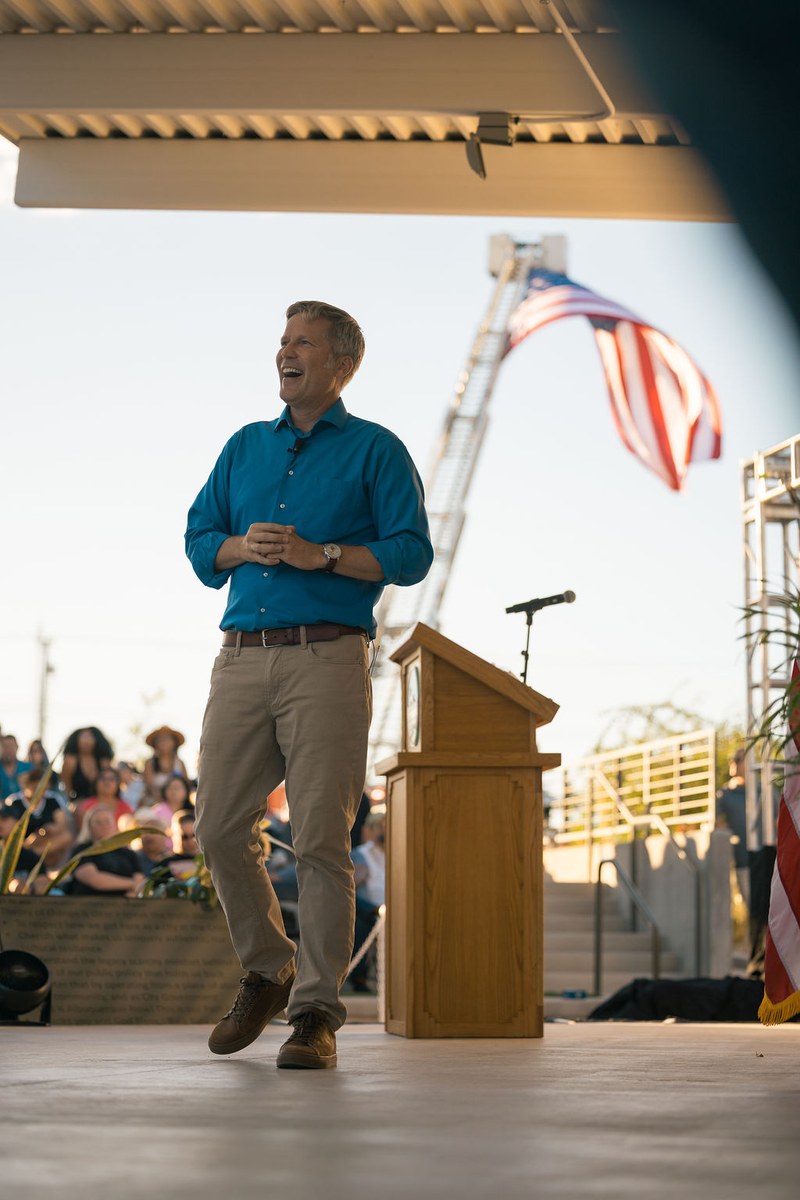
Speaking in front of a packed amphitheater space at the Route 66 Visitor Center, Keller described Albuquerque as a “city at the crossroads” whose history has created an extraordinary resilience. Generations of Burqueños learned to protect scarce land, water, resources, culture and opportunity through periods of upheaval and change.
Those instincts helped Albuquerque endure and preserve the culture and identity that make the city unique. That resilience, and our ability to hold onto our cultural identity while living together across our differences, remains one of Albuquerque’s greatest strengths and offers an example in today’s fractured America. But Keller said the scarcity mindset that once helped us survive still shapes too much of modern public policy, from how we divide public resources and manage City land and buildings to how we approach problem-solving itself.
For his third term, Keller is challenging City government to work differently by starting with safety, removing unnecessary barriers, expanding choices, sharing resources the City already has, and making government tangibly useful in people’s everyday lives.
“This is not about you, not about me, it’s about us together,” Keller said. “Let’s answer some core questions that vex us today and get to a theory of change for tomorrow.”
He was clear and direct about his goals and commitment during his third term: First, shift the City’s approach to policymaking toward an abundance mindset and rebuild Albuquerque’s civic muscle to get things done. Second, restore the broadest sense of public safety for everyone, from people living on the street to families, businesses and those using our public spaces. Third, prove that City government can be genuinely helpful by reducing the friction, frustration and everyday burdens people face.
The approach is unorthodox and cuts against much of the traditional practice of government, where the safest answer is often to wait, evaluate, protect, mitigate risk, add more process, or simply say no. Keller instead outlined how Albuquerque can reconcile our scarcity mindset by demonstrating abundance in everything that we do. He did so without reading a speech, instead opting to share remarks based on “Theory of Change,” (document attached) which maps out his governing strategic plan for his third consecutive term as Albuquerque’s mayor.
The agenda is deliberately nonpartisan; it is not organized around a national political ideology but around a basic measure of local government that asks, “Does it actually make people’s lives better?” Instead, the “abundance agenda” reflects what the mayor has personally heard from Burqueños throughout his nearly 20 years of public service. First, that these are tough times and things don’t seem to be getting better, from cost of living, to raising a family, to doing business. Second, that government historically, at every level, hasn’t been helping – rather it’s been “adding friction” to people’s lives, “grinding folks down on top of all the other kitchen table issues” they face each day.
Public Safety
Keller was upfront that the work of his administration still starts with safety.
“Public safety is a precursor to any form of abundance,” he said. “You can’t move from a scarcity mindset focused on survival to one of growth and abundance when you’re scared.”
He described safety in its broadest sense, encompassing families using parks, people riding buses or walking down the street, businesses opening their doors, and people experiencing homelessness, addiction or behavioral health crises.
That is why public safety and homelessness remain fundamental to the administration’s third-term agenda, even as the State of the City focused more broadly on the way government itself operates. APD will continue working to reduce crime, Albuquerque Community Safety (ACS) will continue providing an alternative response to behavioral health and other nonviolent calls, and the Gateway System of Care will continue expanding pathways from the street to shelter, treatment, and stable housing.
The City will also take a stronger approach to fentanyl, addiction, and other factors driving homelessness, providing safe alternatives and clear pathways to treatment and recovery while restoring shared public spaces for everyone. He challenged the community “to commit to some clear principles, to a public compact that we can do better than leave someone on the street.”
Keller said, “This is difficult work because we have to hold two principles in mind at the same time: compassion for people who are suffering, and a commitment to safety and shared public spaces for everyone.”
The Abundance Agenda
The second part of the abundance agenda is making government itself less burdensome. Affordability is not just dollars and cents. It is also about time, frustration, and the cumulative burden of navigating systems that are harder than they need to be.
Cost of Living and Affordability
“Cost of living is more than paying bills,” Keller said. “It’s also the time and frustration that everyday tasks take from our lives. Government should make everyday life easier, not take more of your time.”
Keller emphasized how that principle will shape work across City government.
For people building or repairing homes and for entrepreneurs trying to open businesses, the City is working to shorten permitting timelines, preapprove more construction plans, use new technology for inspections, and eliminate unnecessary points of delay. For some smaller projects, the City will fundamentally reverse the traditional relationship between residents and government.
“We are switching the default to ‘yes,’” Keller said. “Instead of ‘wait for the City to start,’ it’s ‘start and the City will catch up.’”
The City will also launch a “backyard exchange” connecting excess produce and eggs from local gardens, farms and home growers with families around the city who can use them. It’s another example of the abundance principle of connecting resources that already exist with people who need them.
Democratizing Housing and the Freedom to Choose What Is Your “Home”
Housing is another major focus of the abundance agenda. After legalizing casitas, reducing parking requirements, and making other zoning changes to enable more housing, the City will continue looking for ways to give residents more freedom to decide what a home can look like, including duplexes, cottages, condos, casitas and alternative construction methods.
Affordability Also Means Being Able to Afford More
Keller’s abundance agenda also calls for growing Albuquerque’s economy so families have more opportunities to earn and get ahead. That means building on the city’s competitive advantages in emerging industries including quantum, fusion, and directed energy, while making sure new investment creates good local jobs and supports local businesses through tools like community benefit agreements.
Democratizing City Buildings and Land
The City is also putting its own assets to work. For generations Albuquerque has accumulated land and buildings that are vacant, underused, or being held in case they might someday be needed. An abundance mindset requires asking whether those public resources could be doing more for residents right now.
“Part of pushing back on our scarcity mindset is sharing what we don’t need,” Keller said. “This is your land. It’s taxpayer land, and it’s time we democratize it and give you the freedom to use it.”
Through the new Available City Properties program, for example, the City is opening hundreds of properties for potential purchase, lease, or community use. Land could become housing, businesses, gardens, gathering spaces, or other neighborhood assets rather than remaining vacant indefinitely.
The administration will take a similar approach to City-owned buildings and public facilities. Underused space could support childcare providers, community organizations and other services, while community centers, pools, gyms, theaters, and other facilities will be available for more evening and weekend use.
Reducing Friction on Families
For families, Keller said those changes are about making it easier to live a good life in Albuquerque. A birthday party should not require navigating layers of government bureaucracy. A youth sports team should be able to find an affordable place to practice. A childcare provider should not be stopped because usable space is sitting empty. A neighborhood should not have to watch vacant public land remain fenced off for decades.
Together, the initiatives outlined in the State of the City represent Keller’s broader theory of change for the next three-and-a-half years: restore safety, rebuild Albuquerque’s ability to get things done, and prove that local government can reduce rather than add to the pressures people experience every day.
“By giving people more choices, sharing what government does have and making it easier to do things, we can reduce the pain of daily living,” Keller said. “That is our City abundance agenda; that we all feel safer and feel better about City government because it actually is helpful in our daily lives.”
Today’s address also highlighted Burqueños putting those ideas into practice, including Pete Kassetas, owner of Outpost 1706 in Old Town; Eli Cuna, executive director of The Semilla Project; and Meredith Scott, a mother whose children have found a favorite “third place” at the newly improved Wells Park, which has become a destination for families in the region.
Their stories helped illustrate the mayor’s larger argument that Albuquerque does not lack people with ideas, families who care about their neighborhoods, or resources that can be put to work. Too often what is missing is a system that connects them and gives them room to act.
At a time of deep political division nationally and in New Mexico, Keller said Albuquerque has an opportunity to pursue a different path rooted in the city’s own history and identity.
Keller also challenged leaders across Albuquerque and New Mexico to bring the same abundance mindset to the region’s biggest decisions. Investing in people and infrastructure, supporting transformative projects, and moving beyond the tendency to repeatedly relitigate major investments rather than getting them built.
“We are the city at the crossroads,” he said. “We need each other’s help to transcend all that has held us back, to keep our cherished authentic cultural core, and to grow into the city of shared prosperity we are capable of.”
The challenge of Albuquerque’s next chapter will be to take the resilience that allowed generations of Burqueños to survive scarcity and use it to build something more: A safer city, a government that works for people, and an Albuquerque where more is possible.
Watch a recording of Mayor Keller’s 2026 State of the City address.
Read a copy of the remarks here: 2026 State of the City
More than 1,200 people were expected at the facility on a warm Saturday night with views of the city and a neon sign park backlight by an iconic New Mexico orange and gold sunset. Keller continued his “Metal Mayor” tradition, Keller began his address by walking out to the song “My Place In The Dirt” by Demon Hunter and walked off to “The Nurturing Glance” by Soilwork.
###