

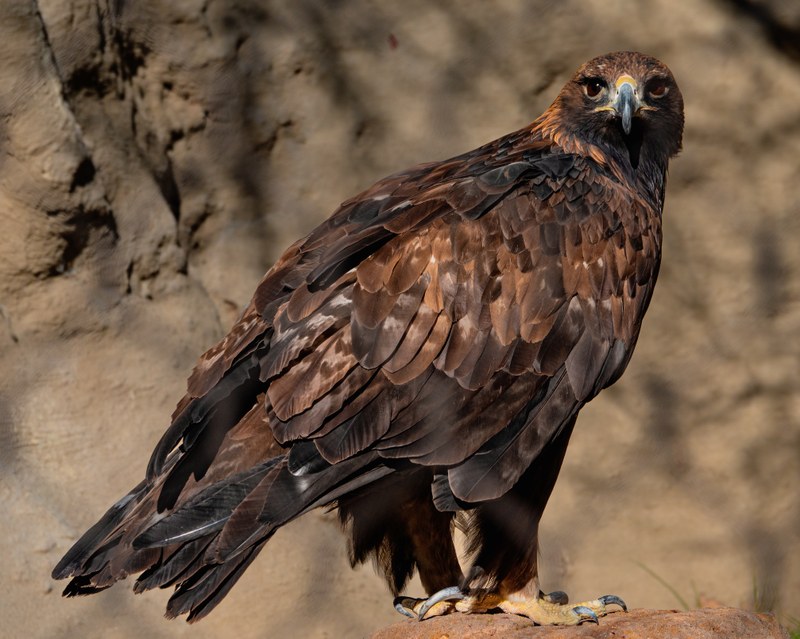
A Golden Opportunity: Rescued Golden Eagle Now Calls ABQ BioPark Home
A golden eagle, who lost his ability to fly due to an injury in the wild, has a new home at the BioPark and a second chance at life.
December 18, 2025
Thanks to the dedication of several local organizations and individuals working together, a rescued golden eagle now calls the ABQ BioPark Zoo home.
“Golden eagles are such impressive, gorgeous birds and we’re very honored to have him here,” said BioPark Curator of Birds Karen Waterfall. “Being able to see him in a close setting like this is a special opportunity for visitors, and we’re proud to be able to give this eagle a good life.”
The male golden eagle, named Danny Boy, moved into his Raptor Roost habitat on December 17 after a behind-the-scenes acclimation period. His care team describes him as a calm and chill bird, and say he is settling in great to his new home.

Danny Boy explores his new habitat in Raptor Roost at the Zoo.
Prior to his rescue in February 2025, life was much more uncertain for Danny Boy. He was found by BNSF Railway track inspector Michael Judd hobbling down a remote set of rail tracks near Coolidge in northwestern New Mexico.
“The closer I got, the more I realized he must be hurt, and I couldn’t just leave him out there,” Judd recalled. “I used my vest to cover him and he let me pick him up and then I realized ‘oh, I got an eagle in my truck.’”
Judd started making some calls and was connected with Hawks Aloft, who agreed to take in the eagle. Based in Albuquerque, Hawks Aloft is a nonprofit organization dedicated to rescuing and rehabilitating birds of prey and protecting wild birds and their habitat throughout New Mexico.
“When he first came in, we didn’t know if he would survive,” said Hawks Aloft Executive Director Gail Garber. “He was so skinny and had a deep wound near the knee. We noticed his wing was also drooped and found out he had an infection in his shoulder.”
With Hawks Aloft, Danny Boy received antibiotics immediately and had surgery to repair the wound on his knee. Unfortunately, the infection near his shoulder caused the bone to deteriorate there, leaving him unable to fly, and therefore he was deemed unreleasable. Nevertheless, Garber is still happy Danny Boy has a second chance at life after all he’s been through.
“We’re not sure how he got injured,” said Garber. “We've speculated he may have been trying to hunt something that decided to bite back, or he got in a fight with another eagle. He certainly didn't get hit by a car because he was not anywhere near a road, so it's a miracle that anybody found him.”
“He’s got a strong will to live,” Garber continued. “He was in our care for 184 days, and once we were able to get his weight up and close the wound on his knee, we knew he would be okay. He is really mellow, and I think he'll be great for the zoo. They'll love working with him.”

Danny Boy pictured on the first day of being in his new habitat.
While behind-the-scenes, Danny Boy received additional treatment from the BioPark's dedicated vet team. Since he can no longer fly, he'll be kept comfortable with low perches to help him navigate his habitat and his care team will continue to keep a close eye on his health. Waterfall said it makes her happy knowing that Judd took the time to rescue the bird, and that the BioPark team was excited to partner with Hawks Aloft.
“I've always heard really good things about Hawks Aloft, so getting to meet everyone was really wonderful, and hopefully we can move forward with this relationship,” she said.
As for Judd, he looks forward to being able to visit Danny Boy at the Zoo with his family and said what he hopes others take away from Danny Boy’s story is to be kind to animals, but to also be cautious. Birds of prey are equipped with sharp beaks and talons, and must be approached carefully as even an injured bird can potentially strike in defense.
If you come across an injured bird, please contact a licensed wildlife rehabilitator. For additional resources and information on how to help injured or orphaned wild birds, visit the City of Albuquerque’s Environmental Health page.