

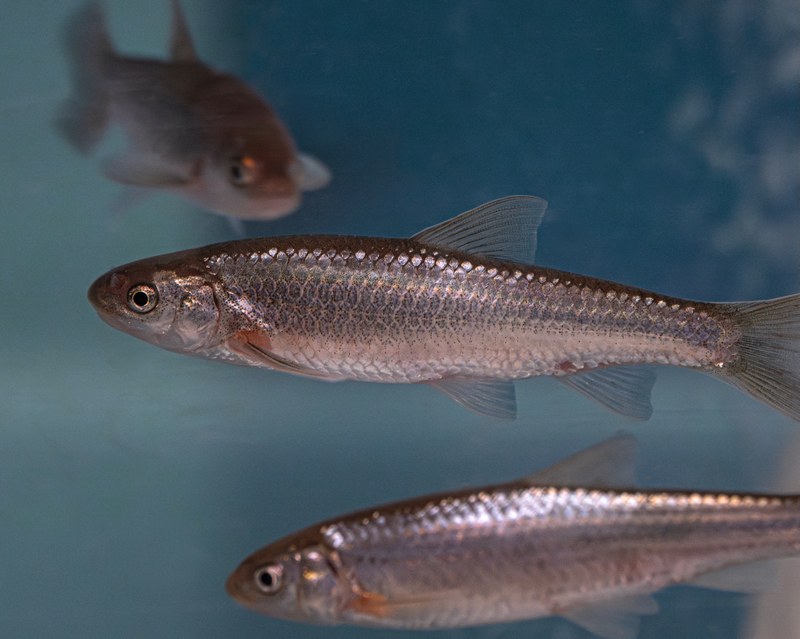
The Tiny Fish Holding a River Together
The endangered Rio Grande silvery minnow benefits the river and all who rely on it more than people may know.
On a sunny morning in Albuquerque, people are already gathering along the Rio Grande.
They walk their dogs beneath the cottonwoods, ride through the bosque, cast fishing lines from the bank, or stop for a few minutes to look out over the water.
Few are thinking about a fish that could fit in the palm of your hand.
Many New Mexicans may not even know the Rio Grande silvery minnow exists. Yet this endangered fish is closely tied to the river people care about so much.
“If you enjoy the river, thank the fish,” said Patrick Horley, curator of the ABQ BioPark’s Aquatic Conservation Facility (ACF). He is a conservationist who oversees the BioPark’s silvery minnow conservation program.
Horley makes one thing very clear: if it weren’t for the minnow, there would no longer be much of a river left to love. The silvery minnow is listed as a federally endangered species. This designation is critical, because it means that its remaining habitat receives protections that help keep water in stretches of the Rio Grande. That water also supports the cottonwood bosque, wetlands, farms, wildlife, and communities along the river.
Horley says there is sometimes a misperception that the fish adds competition for water, especially during drought years when there is increasing need for irrigation for crops.
“But here is the thing I wish everyone better understood—the fish aren’t taking water from farmers,” Horley said. “They’re bringing water to farmers.”
Water that remains in the Rio Grande continues moving through the larger system and reaching communities downstream. Most people will never notice a silvery minnow beneath the surface, but they would notice if the river no longer had enough water to sustain the bosque around it.
A river he could cross in dry shoes
The conservation team has called 2026 the worst water year it has experienced in 13 years.
Horley has worked through eight silvery minnow spawning seasons. During his first, the river was running so high that crews could not safely enter the water to collect eggs.
This year, he crossed parts of the Rio Grande without getting mud on his shoes.
“It was almost dust,” he said.
Some stretches that typically begin drying in June lost water much earlier. Channels narrowed, pools separated from the river, and fish were left in shallow pockets as the water receded.
The team watched the forecast and waited for rain.
Silvery minnows spawn when rising water signals that runoff or a storm has reached the river. Their eggs drift with the current, leaving crews with a limited amount of time to find and collect them. The eggs are then brought back to the BioPark, where the team raises the young fish until they are ready to be released into the Rio Grande.
During spawning season, Horley keeps camping gear and a change of clothes at work. He also keeps bread and peanut butter nearby because a morning in the field can easily turn into a much longer day.
“If it rains, we are out there the next morning,” he said.
Crews may leave before sunrise or work late into the night. They enter the river carrying nets and collection gear without knowing whether they will return with thousands of eggs or almost none.
In a stronger water year, collecting one egg per minute might have prompted the team to try another site. This year, they collected whatever they could find.

Patrick Horley pauses for a moment during a trip to the Rio Grande to collect wild eggs in April of 2026
From more than 100,000 eggs to 16
The outcome of a spawning season can change dramatically from one year to the next.
In 2020, crews collected more than 100,000 eggs in a single day. In 2022, they collected none. The following year, they found 16.
Rain must arrive at the right time, enough water must move through the river and the female fish must be ready to spawn. When one of those pieces does not line up, an entire breeding season can be affected.
Last year, biologists found female minnows stranded in pools that were no longer connected to the Rio Grande. They brought the fish to the BioPark before the remaining water disappeared. Staff were able to spawn many of them at the ACF, producing more than 100,000 eggs that otherwise likely would have been lost.


Eggs are counted at the Aquatic Conservation Facility and baby fish, called fry, are raised by the ABQ BioPark's expert team. As they mature, they may breed or be released into the Rio Grande.
Silvery minnows generally live for only about two years in the wild. Their population can respond quickly after a successful season, but several poor years can cause an equally rapid decline.
“If we get two good years in a row, they could be almost common again,” Horley said. “But three bad years, and they’re done.”
Six other native Rio Grande fish that reproduced in a similar way have gone extinct. The silvery minnow is the last one remaining.
Keeping the work going
When the river does not provide the conditions the fish need to reproduce successfully, the BioPark team raises young minnows for release. Staff monitor their health and water quality, maintain pumps and tanks, and care for the fish as they grow in preparation for release day.
This fall, in collaboration with the U.S. Fish and Wildlife Service, the ACF team released about 34,900 silvery minnows into the Rio Grande across two locations in Albuquerque, and an additional release of about 5,000 minnows is scheduled for before the year's end. Considering the brutal dry stretch of the river this summer, this year’s releases are especially important for replenishing the silvery minnow population.
Unfortunately, the silvery minnow conservation program at the BioPark recently lost roughly $150,000 in annual federal support. The loss limits how many fish the team can raise and leaves less money to replace worn equipment or respond to unexpected problems.
Fieldwork brings its own costs. A storm may create an opportunity to collect eggs with very little warning. The team needs reliable vehicles, working nets, collection supplies, and enough capacity at the facility to care for what crews bring back.
Support through the New Mexico BioPark Society helps meet those needs. Donations can help maintain the systems that keep young fish alive, replace equipment that can no longer be repaired, and make sure the team is ready when conditions change in the river.
Horley sometimes reads the comments on stories about the silvery minnow. People ask why so much effort and money should go toward a fish they may never see.
He says that it’s a fair question, especially for someone who has never heard how closely the fish’s future is connected to the river, but like us, the minnow relies on the Rio Grande. As an endangered species, the protections attached to the fish help preserve the water.
Horley hopes there will come a day when the species can recover without this level of human help.
“I’d love it if the Aquatic Conservation Facility didn’t have to exist,” he said. “I wish aquaculture didn’t have to exist because the river was so plentiful.”
For now, the team keeps watching the weather and when rain reaches the river, they have to be ready to leave, collect what they can, and bring the next generation of minnows safely back to the BioPark.
Whether they can keep doing that depends on having enough people, working equipment, and space to care for the fish they find.
Every minnow returned to the Rio Grande is another chance for the species to remain part of the river and for there to be a river that New Mexicans know and love.


Staff from the ABQ BioPark's Aquatic Conservation facility monitor fish in transport tanks as they pump in water to acclimate them to the river's temperature before they are released into the wild.
The fish are tagged with a UV reflective marking so that they can be identified by field researchers in the future, the colors change each year to aide in data collection.