

ABQ BioPark Celebrates Rio Grande Cooter Release and New Facility for the Near-Threatened Turtles
The wild release and new behind-the-scenes propagation facility mark a big year for Rio Grande Cooter conservation at ABQ BioPark!
ABQ BioPark is proud to be an active participant in Rio Grande cooter conservation, studying how to best support them in human care and releasing offspring into their native range when able to help support the wild population.
On Tuesday, Sept. 15, BioPark staff released three of these freshwater turtles into the Black River near Carlsbad where the species occurs in the wild. The turtles were hatched at the BioPark in 2023 and were given three years to grow before release, helping them reach a size that makes them less vulnerable to predators. Each turtle was also microchipped so they can be identified if encountered again in the future.
Rio Grande cooters are native to the lower Rio Grande and Pecos River drainages in New Mexico, Texas, and Mexico. They are listed as Near-Threatened by the International Union for the Conservation of Nature and are considered a Species of Greatest Conservation Need in New Mexico, where their populations are small and isolated.

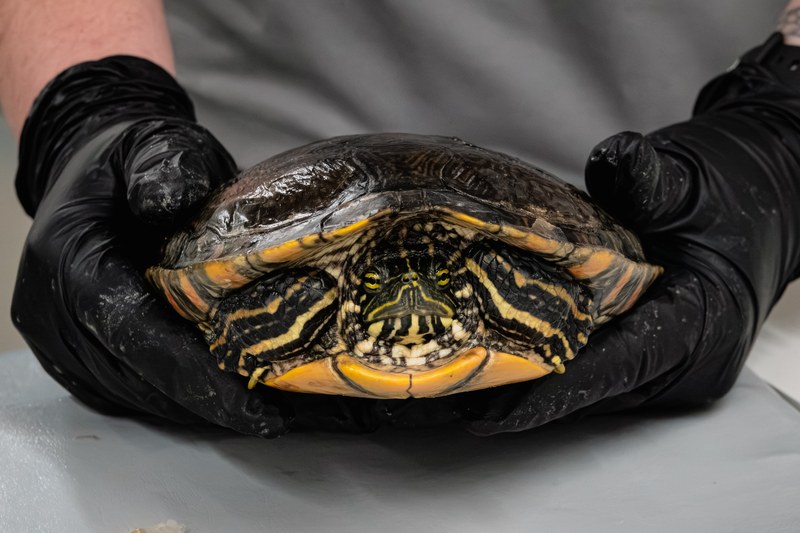
Close up of a resident Rio Grande cooter at ABQ BioPark who is about to enter their new behind-the-scenes habitat.
For the BioPark team, release day offered a chance to see years of care, research, and learning put into action.
“Releasing them really drives home that our actions can make a difference,” said Stacey Sekscienski, curator of herpetology at the ABQ BioPark. “We have learned so much from caring for this species, and now we are able to put that knowledge toward supporting these turtles in the wild.”
The BioPark previously released three Rio Grande cooters in 2023, making this the latest step in a conservation effort that has been growing for nearly a decade.
Like many species that depend on freshwater habitats, Rio Grande cooters face a range of pressures, including drought and water depletion, changes in water quality, habitat fragmentation, rising temperatures, and predation. Those challenges make understanding how to maintain healthy populations increasingly important.

Reptile care specialist Trinity McCoy holds a resident RGC turtle during a health exam in preparation for their move into their new behind-the-scenes habitat.
Conservation work for Rio Grande cooters began at the BioPark in 2017, when a small assurance population was established at the Zoo. Since then, animal care staff have been learning more about how to successfully care for this species. The goal is to develop reliable care and breeding practices so the BioPark has the expertise and a healthy population available to support conservation efforts if wild populations need help.
The program is continuing to grow through a conservation partnership with Chevron which helped fund a behind-the-scenes propagation facility for Rio Grande cooters at the zoo that supports the BioPark’s ongoing care and breeding of this species.
The new facility provides more progressive housing for the turtles thanks to new custom fabricated fiberglass tanks and an upgraded filtration, heating, and insulation system. More robust terrestrial areas were also added to provide them more space to bask in the sun and to encourage more natural nesting behaviors.


Members from the reptile care team are pictured next to one of the new RGC habitats. Pictured from left are Deven Cummings, herpetology curator Stacey Sekscienski, and Trinity McCoy.
In the right photo, three RGC turtles sitting in the terrestrial portion of their habitat make their debut into the new prorogation facility.
Currently, the plan is to house the adults in the outdoor facility year-round, providing them with natural temperature and light fluctuations important for breeding success and health.
Chevron’s involvement has also helped strengthen connections in southeastern New Mexico. That network is an important part of what success looks like, with organizations working toward a shared goal and continuing to learn more about what Rio Grande cooters need in New Mexico.
“Turtles have an important role in their ecosystems, as they are both predators and prey,” Sekscienski said. “But they also have an intrinsic value. They are beautiful and magnificent animals. We want to keep building our understanding of them and what they need to thrive in New Mexico.”