

City Celebrates One Year of Gateway System of Care Programs
Medical Sobering, Men’s Housing, Women’s Housing Expansion serve thousands across Albuquerque
The City of Albuquerque has built something truly unique: the Gateway System of Care, an integrated network of medical sobering, housing, treatment navigation, recovery, and permanent housing services that together form a continuum found nowhere else in New Mexico.
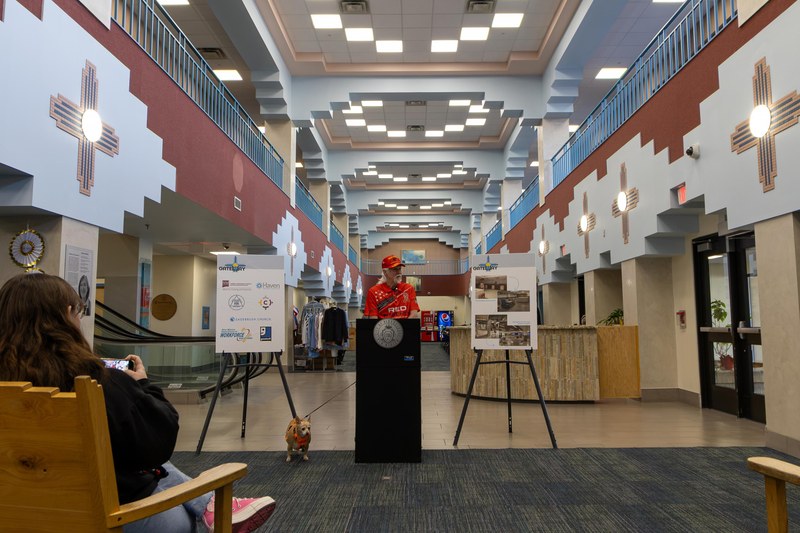
Today, Mayor Tim Keller joined Department of Health, Housing & Homelessness Director Gilbert Ramírez and Gateway partners to celebrate one year of three major milestones: Gateway’s Medical Sobering Center, the Men's Housing and Treatment Navigation Center, and the expansion of the Women's Housing and Treatment Navigation Center, all launched in October 2025.
"What we have here is unique. No other city in New Mexico has built this kind of system,” said Mayor Tim Keller. “We made a decision to invest in a real continuum of care, and after one year of real results, we want to continue the momentum and build on something we know is working.”
Opened in October 2025, the Gateway Medical Sobering Center became the fourth sobering program owned and operated by Horizon Treatment Services, a California-based agency with nearly two decades of providing clinically supervised sobering care. Since opening, Gateway Medical Sobering Center has recorded 5,125 admissions and has received 4,573 referrals. The center provides an alternative to emergency department care for individuals experiencing acute intoxication whose needs can be safely managed in a sobering center, making it a valuable addition to Albuquerque's public health resources.
Before the center opened, first responders had limited options for individuals who needed observation but not emergency medical intervention. The center fills that gap by freeing ambulances and emergency department capacity while connecting patients to recovery pathways.
Gateway Medical Sobering Center’s services include medical screenings, nursing assessments, vital sign monitoring, peer support, and individualized discharge planning, including direct connections to the broader Gateway System of Care. Every client receives education and referrals before discharge, and at the end of its first year, 44% of clients were linked directly to the next level or care, such as detox, treatment or housing.
“Over the past year, Gateway Medical Sobering has given Albuquerque’s first responders a better option, and more than 4,000 times, someone in crisis was met with medical care, dignity, and a connection to what comes next,” said Eliseo Becerra, Chief of Strategic Growth & Special Operations, Horizon Treatment Services. “We’re proud to partner with the City of Albuquerque, and grateful to our staff, who show up around the clock for their neighbors.”
The Gateway Men's Housing and Treatment Navigation Center launched in phases beginning October 2025, reaching its full capacity of 92 beds by January 2026. In its first year, the program served 370 men and moved 72 into permanent housing, maintaining a 97% occupancy rate since reaching full capacity. The program is operated by Community Bridges, Inc. under contract with the City.
The center provides a 24/7 housing-focused program integrating shelter, intensive case management, behavioral health coordination, medical referrals, and housing navigation under one roof. Every resident receives an individualized service plan and dedicated case manager. Beyond housing, 16 residents have been connected to substance use treatment, 3 referred to the Gateway Young Adult Housing and Navigation Center, and 2 linked to the Veterans Integration Center.
Looking ahead, the program is expanding its behavioral health and recovery services by adding intensive outpatient programs, medication-assisted treatment, and workforce development services. Additional funding approved by the Albuquerque City Council for treatment navigation will support that expansion.
Charles Montgomery shares his experience of moving through the Gateway program into an apartment of his own
"No two people who walk through our doors have the same story, and no two paths forward look exactly alike,” Elisa Gomez Garcia, Senior Program Manager of Housing, Community Bridges, Inc. “What this first year has shown us is that when you meet people where they are, invest in the relationship, and give them real tools, they move forward.”
Women's Housing and Treatment Navigation Center served 565 in its first year of expansion. The program expanded by 50 new beds in October 2025, bringing the total women's housing capacity at Gateway Center to 100 beds. Since the expansion, 565 women have been served, with 89% connected to a next step: housing, treatment, or transitional housing. The program is operated by Chicanos Por La Causa and funded through a $1.35 million intergovernmental agreement with the State of New Mexico.
Services include intensive case management, access to Ideal Option outpatient substance use disorder treatment, certified peer support workers, and workforce training and job placement. Referrals come from Gateway West, ACS, and community partners.
"Women experiencing homelessness face a distinct set of barriers, and they deserve a program that takes that seriously,” said Regina Tobey, Homeless Innovations Division Manager with the City. “This expansion has given our residents access to the intensive, individualized support they need and deserve.”
These three programs are milestones within the larger Gateway System of Care — the City's integrated network of services for individuals experiencing homelessness and behavioral health crises. In FY26, the system served 8,126 people across all programs, including Gateway West (3,185), the First Responder Receiving Area (2,272), Gateway Family (598), Women's Housing (470), Men's Housing (311), Medical Respite (121), Gateway Recovery (79), and Gateway Young Adult (44). The system's reach extends beyond city limits: residents from surrounding communities across the region come to Albuquerque because of what the city has built here.
That reach reflects both the scale of what Albuquerque has built and the gap that still exists across New Mexico. The Gateway approach has gained national recognition. In 2025, the model was presented at the National Latino Behavioral Health Association's annual conference, contributing to a growing national conversation about building effective systems of care at the local level.
The City is committed to expanding what Gateway offers, including transitional housing, which has declined 56% in Albuquerque since 2011. Transitional housing is a critical bridge between shelter and permanent housing, and closing that gap is a priority for the year ahead. Sustaining and growing a system of this scale takes partners: state investment, federal support, providers, and community commitment. Albuquerque has shown that the model works. The next step is to build on that work together.
"Every person who walks through the doors of any one of these programs made a choice to ask for help, to try something different, to take a step toward something better,” said Director Gilbert Ramírez, Department of Health, Housing & Homelessness. “Our job is to make sure that choice leads somewhere real. That means a system with enough options, enough capacity, and enough sustained investment that no one falls through the cracks.”