
Albuquerque’s Newest Gateway Is Changing What’s Possible for Young People
City’s first facility for young adults affected by homelessness crisis provides a true path forward
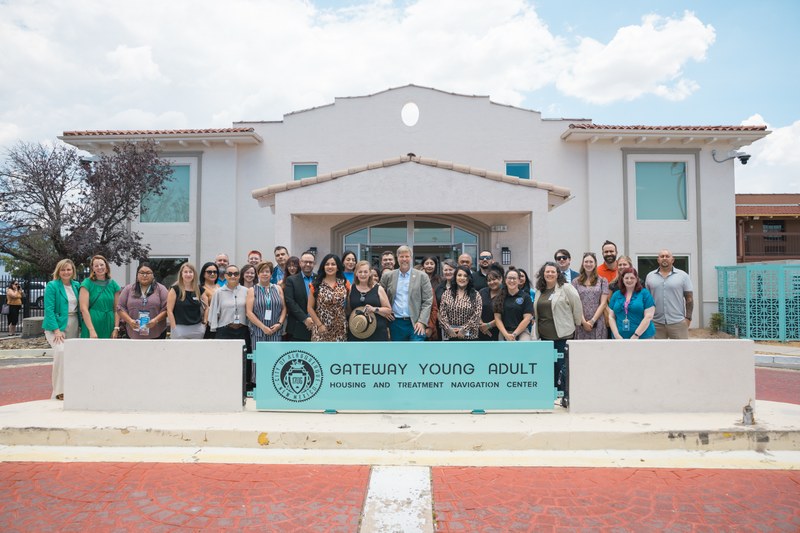
Gateway Young Adult Housing and Navigation Center, the first City-owned facility dedicated to those ages 18-25 experiencing homelessness, hit the three-month mark this month. A showcase celebrating this milestone featured Mayor Tim Keller along with the project’s partners as well as city, state, and community leaders at its location on San Mateo.
The event highlighted the center’s programming, its cross-sector origins, and the gap it was built to fill: A 2022 Comprehensive Needs Assessment found that between 1,242 and 2,314 young people ages 15-25 were experiencing homelessness or housing instability across Bernalillo County, including in Albuquerque. Opened in April 2026 and operated by Youth Development Incorporated (YDI) together with the City’s Department of Health, Housing & Homelessness (HHH), the center provides a place to stay along with the behavioral health, job readiness, and life skills support needed to move toward permanent stability.
A particularly notable moment from the event was a speech from an 18-year-old Gateway Young Adult resident, who shared about their journey to the Center, the support they’ve received, and the bright future they see in front of them.
The 2022 assessment, conducted by the Pacific Institute for Research and Evaluation in partnership with the City, Bernalillo County, and the state of New Mexico, called specifically for a coordinated youth-specific resource that could address the full range of barriers young people face – not just a bed, but help with the life basics required for self-sufficiency all in one place. Gateway Young Adult was built to be exactly that.
“Opening this center was the beginning of something important and impactful,” said Mayor Tim Keller. “The work now is making sure every person who comes through those doors leaves with a real path toward stability. That’s what this city is committed to and what this place is for.”
Located at the former San Mateo Inn – a City-owned property converted through coordinated public investment – the center provides transitional housing for up to 41 young adults at a time, with 90-day stays designed to move residents toward permanent homes. Comprehensive services integrated into the program include housing navigation, trauma-informed case management, behavioral and mental health support, job readiness training, financial literacy guidance, life skills development, and daily meals. A typical week on campus might include resume building, career exploration, coping-skills workshops, interview prep, and money planning sessions – practical skills that make the difference between a temporary stay and lasting success.
In its first three months the center has served 47 clients. In that short time, 10 have secured stable housing or an apartment, seven have gained employment, and two have earned their GED or high school diploma. For a population that research shows is at heightened risk of adult homelessness, trafficking, and long-term economic hardship, those outcomes represent trajectories changed.
The center’s reach extends well beyond its own walls. Young adults are arriving through a remarkably broad referral network spanning more than 50 organizations and systems, from Gateway West and the Gateway Medical Sobering Center to Presbyterian Hospital, UNM Hospital, APS McKinney-Vento, CYFD, the Law Office of the Public Defender, the Transgender Resource Center of New Mexico, and dozens of community-based organizations. That network reflects both the complexity of the young people the center serves and the depth of cross-sector investment in getting them connected to the right support.
“What makes Gateway Young Adult different is the approach,” said HHH Director Gilbert Ramírez. “We built this center around what young people actually told us they needed: a place that feels safe, services that meet them where they are, and a team that believes in their potential. The broad collaboration made this possible.”
Notable is not just what happens at the center, but the growing network of alliances around it. The Office of Equity and Inclusion is working with local banks and credit unions to host financial literacy workshops twice a month with plans to offer on-site bank account openings for residents who may be banking for the first time. Goodwill is partnering with the center on workforce development, and outreach is underway to connect residents with CNM and UNM for information sessions and admissions support. The Department of Health is offering on-site health screenings and clinical services, while Albuquerque Community Safety will bring its Summer of Nonviolence programming to campus.
Trade and workforce connections are expanding through partnerships with Iron Works Union, the Carpenter Union, Job Corps, WIOA, and Growth Opportunities, leading to solid careers for young adults who are ready to work. APS McKinney-Vento supports residents who are still working toward their high school credential, and YDI’s own GED program provides an on-campus option. For residents’ holistic wellbeing, volunteers will lead art classes and yoga sessions, and a mentorship initiative is taking shape to connect residents with local business owners and younger entrepreneurs. A resource fair with Goodwill is planned for August, adding another access point for employment services.
“Every day at Gateway Young Adult we’re seeing the power of someone finally having the stability to focus on their future,” said Jack Simalu, Vice President of Prevention, Intervention & Behavioral Health (PIBH) with YDI. “Our residents are finding housing, building resumes, opening bank accounts, exploring career paths, and connecting with mentors. The wraparound model means we can embrace each person as they are and walk alongside them toward something better.”
The center was made possible through a sustained cross-governmental investment totaling more than $15.5 million. The City of Albuquerque committed $4 million in general obligation bond funds and $3.3 million in federal ARPA funds toward shelter operations and buildout, along with $3.7 million in additional federal ARPA resources. The state of New Mexico contributed $3 million through a state affordable housing grant used to purchase the property, along with $1.5 million in state appropriations for shelter operations.
The City’s vision for the site extends beyond what exists today. Phase 2 plans, currently in design, call for 30 more beds, increased community space, and the development of an on-site park hoped to break ground this fall. While Phase 2 is not yet fully funded, the City’s commitment to growing the center reflects a long-term investment in young people, not a short-term fix.
For those who walk through the doors of Gateway Young Adult, the center represents something the needs assessment said they wanted most: a safe place that feels like theirs, with real support and people who believe in them. For Albuquerque, it shows a City that heard what its young people needed and built it.
The Gateway Young Adult Housing and Navigation Center is part of the City of Albuquerque’s Gateway System of Care, operated in partnership with Youth Development Incorporated. For more information, visit cabq.gov/health-housing-homelessness/gateway-system-of-care/young-adult-campus or call 311.